Mezcal vs Tequila: Complete 2025–2026 Comparison Guide
After 10+ years visiting palenques and distilleries across Mexico, here's my honest, updated comparison of these two agave spirits—covering what's changed in 2025–2026 and what actually matters when choosing between them.
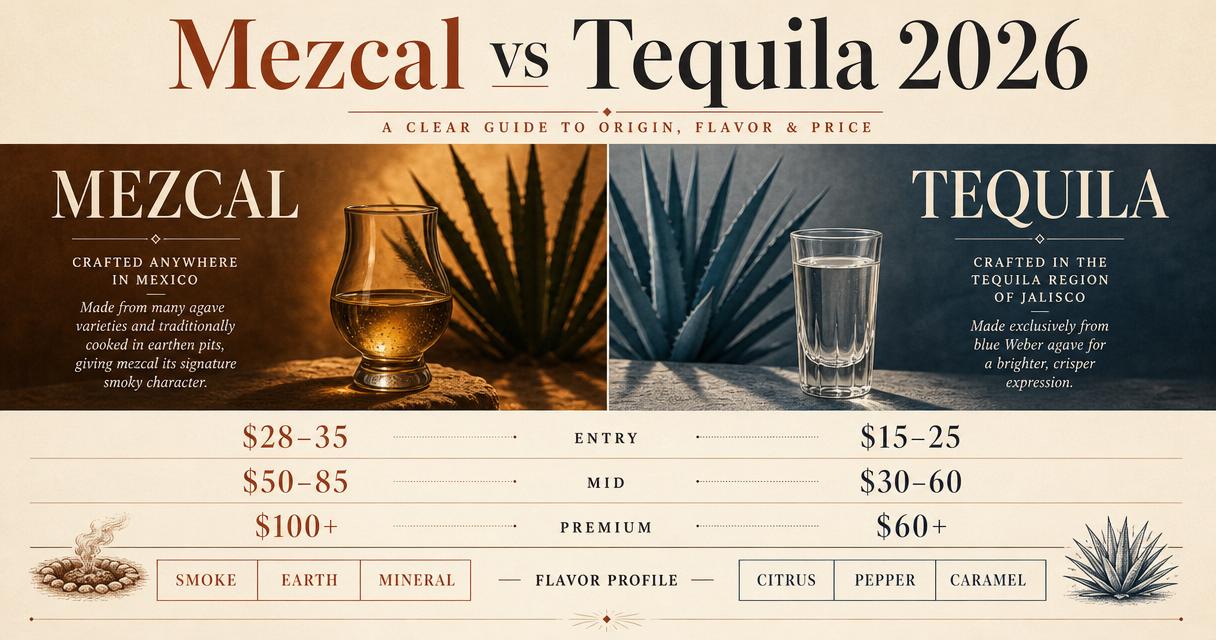
Quick Answers: Mezcal vs Tequila 2026
- Is mezcal more expensive than tequila?
- Yes. Mezcal costs 50-80% more at every price tier. Entry-level mezcal: $28-35. Entry-level tequila: $15-25. The gap is structural — mezcal agaves take 7-35 years to mature vs 6-8 for tequila.
- What is the main flavor difference?
- Mezcal tastes of smoke, earth, and minerals from pit-roasting. Tequila tastes of citrus, pepper, and caramel from steam-cooking. Mezcal's 50+ agave varieties create far more flavor diversity than tequila's single blue agave.
- Which is more sustainable?
- Both have challenges. Mezcal risks wild agave overharvesting. Tequila risks blue agave monoculture disease. Leading brands in both categories are now investing in solutions.
Full breakdown below ↓
The most common misconception I encounter is that mezcal and tequila are interchangeable, with mezcal simply being the "smokier" version. This oversimplification does a disservice to both spirits and the distinct traditions behind them.
Yes, all tequila is technically a type of mezcal—both are distilled from agave. But legally, culturally, and in terms of production and flavor, they occupy very different spaces in 2026. Understanding these differences opens the door to appreciating each on its own terms. If you're new to mezcal, our beginner's guide covers the essentials, and our roundup of the best mezcal bottles shows what to actually buy.
Mezcal vs Tequila: Side-by-Side Comparison (2026)
The key differences at a glance, updated with 2025–2026 pricing and market data:
| Factor | Mezcal | Tequila |
|---|---|---|
| Agave Species | 50+ varieties allowed | Blue agave only |
| Primary Regions | Oaxaca, Durango, Guerrero, + 6 more | Jalisco (mainly), + 4 other states |
| Cooking Method | Earthen pit (traditional) | Steam ovens or autoclaves |
| Distillation | Clay pots, copper, or stainless | Stainless steel or copper pot stills |
| Flavor Profile | Smoky, earthy, mineral, floral—varies by agave | Clean agave sweetness, citrus, pepper |
| Smoke Character | Often present, varies widely | Rarely, if ever |
| Production Scale | Mostly small-batch, artisanal | Mostly industrial, large-scale |
| Price Range (2026) | $28–$300+ (up 10-15% from 2025) | $15–$200+ |
| Agave Maturation | 6–35 years depending on species | 6–8 years (blue agave) |
| Best For | Sipping, exploration, craft cocktails | Cocktails, consistency, accessibility |
Flavor Profile Differences: What Distinguishes Mezcal from Tequila
This is the question I get asked most often, and the answer goes deeper than "mezcal is smoky." The flavor profile that distinguishes mezcal from tequila comes down to three factors: how the agave is cooked, which agave species is used, and where it's grown.
Mezcal Flavor Profile
Pit-roasting + diverse agaves = wide flavor range
- Smoke: From subtle to intense, depending on roasting time and wood
- Earth & mineral: Clay pot distillation adds distinctive terroir
- Tropical fruit: Common in tobalá, cuixe, and wild agaves
- Herbal/floral: Tepeztate brings eucalyptus; espadín offers green apple
- Complexity: Wild yeast fermentation adds unpredictable depth
Tequila Flavor Profile
Steam-cooking + single agave = consistent character
- Cooked agave: Caramel, honey sweetness (clean, not smoky)
- Vegetal: White pepper, fresh grass, green herbs
- Citrus: Lime, grapefruit brightness
- Oak influence: Vanilla, cinnamon in aged expressions
- Consistency: Blue agave produces a recognizable family flavor
The key insight: Two mezcals can taste completely different from each other (a floral tobalá vs. a smoky espadín), while two tequilas from different producers share a recognizable family resemblance. This diversity is mezcal's greatest strength—and what makes comparing them so reductive.
What Flavor Profile Distinguishes Mezcal from Tequila in 2026?
The shortest honest answer: mezcal tastes of smoke, earth, and minerals, while tequila tastes of citrus, white pepper, and caramel. But in 2026, that distinction is getting more nuanced as new mezcal regions push into flavor territory most drinkers don't expect.
Mezcal Flavor Signatures
- Smoke — from earthen pit-roasting
- Earth & wet stone — from clay-pot distillation
- Mineral salinity — pronounced in coastal Oaxacan mezcals
- Floral / tropical — tobalá brings mango, jasmine, ripe pineapple
Tequila Flavor Signatures
- Citrus — lime zest, grapefruit pith
- White pepper — from blue agave's vegetal core
- Caramel & honey — from steam-cooked piñas
- Consistent profile — single agave species (Agave tequilana)
2026 update: Mezcals from Durango and San Luis Potosí are expanding the category's flavor diversity. Durango's cenizo agave delivers brighter, herbaceous mezcals with less smoke; SLP's salmiana brings green-pepper and stone-fruit notes that drink closer to a high-end tequila than a classic Oaxacan espadín. If you've only tried Oaxacan mezcal, these regions are reshaping what "mezcal flavor" means.
Mezcal vs Tequila Price Comparison 2026
Mezcal carries a structural premium over tequila at every price tier — driven by smaller batches, longer agave maturation, and labor-intensive production. Here's what you actually pay in 2026:
Full price breakdown → — tier-by-tier tables, agave maturation data, and matched-price mezcal vs tequila pairs.
| Category | Mezcal | Tequila |
|---|---|---|
| Entry-level | $28–$35 | $15–$25 |
| Mid-range | $50–$85 | $30–$60 |
| Premium | $100–$300+ | $60–$200 |
Why the gap? Tequila's blue agave matures in 6–8 years on industrial plantations. Mezcal agaves take 7–35 years, often harvested wild. A single rare-agave mezcal can require 3–5x the raw agave per bottle compared to industrial tequila.
Is Mezcal More Expensive Than Tequila in 2026?
Yes — mezcal is roughly 50–80% more expensive than tequila at every price tier in 2026. Entry-level mezcal starts around $28–$35 vs $15–$25 for tequila. Mid-range mezcal runs $50–$85 vs $30–$60 for tequila. Premium mezcal reaches $100–$300+ vs $60–$200 for tequila.
The gap is structural, not arbitrary. Mezcal agaves take 7–35 years to mature versus 6–8 years for tequila's blue agave. Mezcal is mostly small-batch, pit-roasted, and hand-distilled in clay or copper. Tequila is overwhelmingly industrial, with steam ovens and column stills built for scale. In 2025–2026, mezcal prices climbed another 10–15% on top of that baseline due to wild agave scarcity.
Bottom line: If price is your priority, tequila wins. If craft, diversity, and traceable sourcing matter more, mezcal's premium is justified.
Mezcal vs Tequila Sustainability Comparison 2026
Sustainability is now a real differentiator between the two spirits — and the picture is more nuanced than "small mezcal good, big tequila bad."
Mezcal Sustainability
- Risk: Wild agave overharvesting (tepeztate, tobalá)
- Progress: Real Minero, Lalocura, Cinco Sentidos run nursery and replanting programs
- Strength: Genetic diversity across 50+ agave species
- Weakness: Firewood demand for pit-roasting can pressure local forests
Tequila Sustainability
- Risk: Blue agave monoculture vulnerable to disease
- Progress: Organic certification growing (Casa Noble, Siete Leguas)
- Strength: Industrial efficiency lowers per-bottle resource use
- Weakness: Vinazas (distillation wastewater) historically contaminate Jalisco waterways
What Is the Best Mezcal for Cocktails vs Tequila?
For cocktails, the choice depends on what you want the spirit to do. Tequila disappears into the drink; mezcal asserts itself.
- Margarita: Classic with blanco tequila. For a smoky twist (Mezcalita), use Del Maguey Vida or Montelobos espadín.
- Paloma: Tequila's grapefruit pairing is iconic. Mezcal works but adds earthiness.
- Negroni / Old Fashioned: Mezcal wins. Smoke and bitterness are made for each other.
- Picante / spicy cocktails: Mezcal — the smoke amplifies chile heat better than tequila.
Rule of thumb: Use $30–$45 espadín mezcal in cocktails. Save bottles over $50 — and any wild agave — for sipping. See our best mezcal bottles guide for specific cocktail-friendly picks.
The Fundamental Difference
Think of mezcal as the broad category and tequila as a specific subset within it. The phrase "all tequila is mezcal, but not all mezcal is tequila" is technically accurate, though in practice, they've evolved into distinct product categories with separate regulations, traditions, and identities.
The key distinction is specificity: tequila is defined by a single agave species, a limited geography, and modern industrial production. Mezcal embraces diversity—dozens of agave species, multiple states, and a spectrum from industrial to deeply traditional methods.
Agave Species: One vs. Many
The most significant difference lies in the agave itself.
Tequila must be made from blue agave (Agave tequilana Weber azul) exclusively. This single-species approach creates consistency but limits flavor diversity. Blue agave is cultivated on large plantations, with plants harvested at 6-8 years of maturity.
Mezcal can be made from over 50 different agave species. From the ubiquitous espadín to rare wild varieties like tobalá and tepeztate, this diversity is mezcal's greatest strength. Each species brings unique flavors, and maturation times range from 6 years to over 30. In 2025–2026, sustainability concerns around wild agave harvesting have pushed producers toward nursery programs and replanting initiatives.
Production Methods: Modern vs. Traditional
How the agave is processed defines each spirit's character. As of 2026, production methods remain the starkest divide between these two spirits.
Cooking the Agave
Tequila: Most tequila producers cook agave in large steam ovens (hornos) or industrial autoclaves. This efficient approach extracts sugars quickly and produces a clean, consistent flavor without smoke.
Mezcal: Traditional mezcal is cooked in conical earthen pits lined with hot stones, then covered with agave fibers and earth. The agave roasts for 3-5 days, absorbing smoke and developing complex caramelized flavors. This is where mezcal's signature smokiness originates.
Crushing and Fermentation
Tequila: Mechanical shredders extract juice from cooked agave. Fermentation typically happens in stainless steel tanks with commercial yeasts, taking 1-3 days.
Mezcal: Many producers still use the tahona—a large stone wheel pulled by a horse or mule—to crush roasted agave. Fermentation occurs in wooden vats or animal hides, relying on wild yeasts over 4-30 days. This slower, less controlled process adds layers of complexity.
Distillation
Tequila: Distilled in stainless steel column stills or copper pot stills, tequila production prioritizes efficiency and consistency.
Mezcal: Distillation ranges from industrial stainless steel to traditional clay pots. Ancestral mezcals must be distilled in clay, which imparts distinct earthy, mineral qualities impossible to replicate otherwise.
2025–2026 Market Update: What's Changed
Both the mezcal and tequila markets have shifted significantly since 2024. Here's what I'm seeing from my latest producer visits and industry conversations in 2025–2026.
Price Trends: Mezcal Up 10-15%, Tequila Stabilizing
In 2025–2026, mezcal prices have risen 10-15% due to agave scarcity, increased certification fees, and rising export logistics costs. A bottle that was $30 in 2024 now runs $34-36. Wild agave expressions have seen even steeper increases (15-20%). Meanwhile, tequila prices have stabilized as blue agave supply recovered from the 2021-2023 shortage cycle. Entry-level tequila remains significantly cheaper than entry-level mezcal.
Sustainability: A Growing Divide
Tequila's blue agave monoculture faces disease vulnerability, while mezcal's wild agave harvesting raises conservation concerns. In 2025-2026, leading mezcal producers have invested heavily in nursery programs and replanting. Brands like Real Minero, Lalocura, and Cinco Sentidos now disclose their cultivation practices. Tequila producers are experimenting with organic certification and regenerative farming. Sustainability has become a differentiator in both categories.
New Brands and Regional Expansion
Mezcal's regional diversity exploded in 2025–2026. Bottles from Durango, Guerrero, Puebla, and San Luis Potosí are now available at specialty retailers nationwide. Tequila has seen celebrity-backed brands flood the market—some excellent (Código 1530), many mediocre. The mezcal newcomers to watch: Lalocura, Cinco Sentidos, and Maguey Melate. For our full brand rankings, see the top 10 mezcal brands list.
The Additive Transparency Movement
In 2025, Mexico's NOM (regulatory body) began requiring greater disclosure of additives in tequila. Many mass-market tequilas use flavor additives—vanilla, caramel, glycerin—to create "smoothness." Mezcal regulations have always been stricter on this front. If you value knowing exactly what's in your bottle, mezcal's artisanal production and stricter labeling give you more transparency in 2026.
Geography and Terroir in 2026
Tequila production centers in Jalisco, particularly around the town of Tequila and the Los Altos highlands. While five Mexican states can legally produce tequila, Jalisco accounts for nearly all production. The volcanic soil and consistent climate create ideal conditions for blue agave cultivation.
Mezcal is produced in nine states, with Oaxaca dominating at over 85% of production. But in 2025–2026, mezcal from Durango, Guerrero, Puebla, San Luis Potosí, and other regions has become significantly easier to find at US retailers. The varied geography—from high mountain villages to tropical lowlands—contributes to remarkable regional diversity that has no parallel in tequila.
Which Should You Drink? A Decision Guide
Neither is "better." They serve different purposes. Here's how to decide based on what you're looking for in 2026:
Sipping Neat?
Choose mezcal. The diversity of agave species and traditional production creates more complexity for contemplative drinking. Start with a quality espadín, then explore tobalá or tepeztate.
→ See our best mezcal for sipping picks
Making Cocktails?
Depends on the drink. Classic margaritas and palomas work best with tequila. For a mezcal negroni, mezcalita, or Oaxacan Old Fashioned, use an espadín at 42-47% ABV.
→ See our best mezcal for cocktails picks
Buying a Gift?
Choose mezcal for impact. A wild agave mezcal with a story behind it creates a memorable gift. Tequila is safer but less distinctive. A $75-100 mezcal outshines a $150 tequila in storytelling.
→ See our best splurge bottles
Just Getting Started?
Start with both. Try a quality blanco tequila (Fortaleza, G4) alongside an espadín mezcal (Del Maguey Vida, Montelobos). Tasting them side by side teaches you more than any guide can.
→ See our mezcal beginner's guide
Cultural and Historical Context
Tequila became Mexico's internationally recognized spirit through strategic branding and commercialization in the 20th century. Large producers built global distribution networks, and tequila became synonymous with Mexico's festive image. Today, major tequila brands are often owned by multinational corporations.
Mezcal remained largely regional until the 2000s, produced in small batches by family operations that had been making it for generations. Its recent popularity has brought both opportunity and challenges—increased demand versus sustainability concerns, tradition versus commercialization. In 2025–2026, this tension is more pronounced than ever.
This cultural difference matters. Buying mezcal often means directly supporting small producers who maintain ancestral practices. It's not just a beverage choice—it's an economic and cultural one.
Common Misconceptions (Updated 2026)
"Mezcal is just smoky tequila"
Smoke is one potential characteristic, not the defining one. Many mezcals are subtle, floral, or fruity. Reducing mezcal to smoke ignores its remarkable diversity—especially true in 2026 as producers from Durango and San Luis Potosí bring very different flavor profiles to market.
"Mezcal is stronger than tequila"
Both typically range from 40-55% ABV. Some mezcals are bottled at higher proofs, but this isn't a categorical difference. A standard tequila and mezcal can be identical in alcohol content.
"The worm means it's authentic mezcal"
The "worm" (actually a moth larva) was a marketing gimmick from the 1940s, not a tradition. Quality mezcal producers never include it, and its presence often indicates a lower-quality product.
"Tequila is lower quality than mezcal"
Both spirits have a full quality spectrum. Excellent tequila exists alongside industrial mezcal. The key is understanding what to look for in each category. In 2026, the additive transparency movement is helping consumers identify quality tequila more easily.
Understanding Both Spirits in 2026
Mezcal and tequila share roots in Mexican soil and agave tradition, but they've grown into distinct expressions of that heritage. Tequila's strength is accessibility and consistency. Mezcal's is diversity and tradition. In 2025–2026, both categories are evolving—tequila toward transparency, mezcal toward sustainability.
Neither deserves dismissal. Understanding their differences allows you to appreciate what each offers—and perhaps discover that you have room in your life for both.
"Don't choose sides. Choose understanding. Both spirits carry centuries of Mexican culture in every sip."
Mezcal vs Tequila: Common Questions (2026)
What flavor profile distinguishes mezcal from tequila?
Mezcal's pit-roasting creates smoky, earthy, and mineral flavors, while tequila's steam-cooking produces cleaner, sweeter agave notes. But the biggest differentiator is agave diversity: mezcal can be made from 50+ species, each with a distinct flavor—tobalá is floral and tropical, tepeztate is herbaceous and wild, while tequila's blue agave delivers a consistent citrus-pepper-caramel character across producers. In 2026, regional diversity adds another layer—a Durango mezcal tastes nothing like an Oaxacan one.
Is mezcal smokier than tequila?
Generally yes, but not always. Mezcal's traditional pit-roasting can create smoky character, while tequila's steam-cooking produces cleaner flavors. However, many mezcals are subtle, floral, or fruity with minimal smoke. The smoke is a possibility in mezcal production, not a guarantee.
Can you substitute mezcal for tequila in cocktails?
Yes, but expect different results. Mezcal adds complexity and potential smokiness to cocktails. A mezcal margarita (mezcalita) has more depth than a traditional margarita. Start with espadín mezcal at 42-47% ABV for cocktails—its balanced profile works well with citrus and agave nectar.
Why is mezcal more expensive than tequila in 2026?
In 2025–2026, mezcal prices have risen 10-15% due to agave scarcity, certification fees, and export costs. Mezcal's higher price reflects smaller production scale, longer agave maturation (7-35 years vs 6-8 for tequila), and labor-intensive traditional methods. Wild agave mezcals are legitimately expensive because plants take 12-35 years to mature. Quality tequila and mezcal can overlap in price at the $40-60 range.
Which should I try first: mezcal or tequila?
Either works as a starting point. If you prefer clean, consistent flavors, start with quality tequila (Fortaleza, G4, Pasote). If you enjoy complexity and are curious about artisanal spirits, start with a balanced espadín mezcal (Del Maguey Vida, Montelobos). Many enthusiasts appreciate both—they serve different purposes and palates.
Discover Mezcal Further
Ready to explore mezcal in 2026? These guides will help: